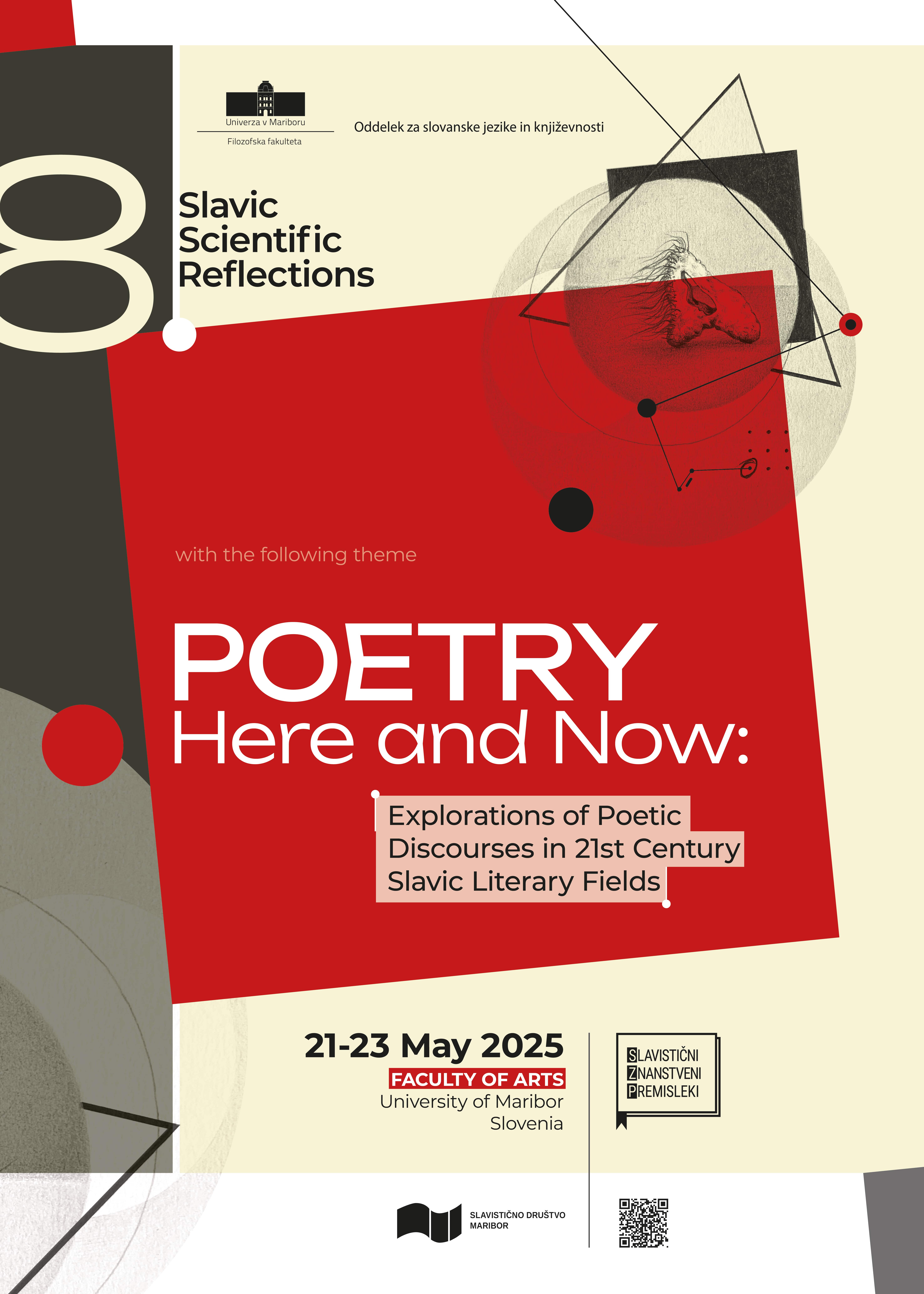
Plakat Poezija Tukaj in zdaj - 8. slavistični znansvetni premisleki

8. SLAVIC SCIENTIFIC REFLECTIONS

Poetry Here and Now: Explorations of Poetic Discourses in 21st Century Slavic Literary Fields

21-23 May 2025, Faculty of Arts, University of Maribor, Slovenia

Why join us in 2025

days of in-depth discussions (May 21–23, 2025)
0
thematic areas of discussion
0
members of the international programme committee
0

Conference

Poetry Here and Now

Explorations of Poetic Discourses in 21st Century Slavic Literary Fields

The Department of Slavic Languages and Literatures of the University of Maribor in collaboration with the Slavic Association Maribor invites you to participate in the 8th International Conference Slavic Scientific Reflections which will take place from 21 to 23 May at the Faculty of Arts in Maribor, Slovenia.

The eighth edition of the conference Slavic Scientific Reflections focuses its research interest on developments in the poetry of Slavic languages and cultures from 2000 to the present. Contemporary literary theory, especially in line with the theoretical heritage of Romanticism, has often defined lyric poetry as a highly subjective and monological genre, even at the end of the 20th century. But the complexity of the configuration of poetic texts in the history of poetry has often undermined the theory, especially with regard to the question of the poetic subject, and contemporary production, with its diversity of practices, has further brought this fact to light. After 2000, it has become even more evident that the notion of lyric discourse as an inward-looking artistic practice that does not involve sociality and does not dialogue with other discourses is no longer tenable. In the context of the global present, recent poetry has significantly uplifted the field of artistic production and has once again entered more visibly into the public sphere with new practices and strategies. This has been facilitated by the advent of the (post-)digital age, which, with new media and new channels of communication, has also led to a reconfiguration of the circulation of literary works. In the context of Slavic cultures, the reconstruction of the functions of literature itself and, in some cultures, especially of poetry as an eminent genre with a specific national-identity role, took place simultaneously in socio-national contexts against the background of the collapse of socio-political systems after the fall of the Berlin Wall. Entering the 21st century in the context of Slavic literary fields therefore also means entering the second decade of transition and/or the post-transition period.

After a prolonged period of declining interest in theoretical questions, theoretical reflection on lyric has experienced a remarkable revival since 2005, and the impression is that theoretical production has been on the rise since 2015. It could even be argued that the ongoing analytical practice and reflections on individual poetic phenomena are lagging behind theory. Against the backdrop of the enrichment of theory fo the lyric with new insights and its analysis with more recent methodological approaches (transnarratology, corpus analysis, stylometry, cognitive poetics, ecocriticism, critical animal studies, etc.), this conference aims to fill this potential gap and stimulate new reflections. We are interested to see how fruitful recent theoretical premises prove to be when applied to poetic discourses emerging at a time of intertwining crises that are affecting the present - from the environmental, to the migratory, to the refugee crisis. What does poetry have to say in an increasingly apocalyptic time of new wars and new realities in which we find ourselves after the pandemic crisis? What are the new strategies of poetry, in which new media is it being realised? What is its relationship with other artistic practices? How does the poetic subject manifest itself in the new poetry emerging in Slavic contexts? What is the role of poetic discourses in Slavic literary fields after 2000? These are just some of the questions we will address and reflect upon.

We kindly invite researchers to contribute papers related to the following thematic fields:

I. THE MEANING-MAKING OF POETIC LANGUAGE: FORMS OF MEANING AND MEANINGS OF FORMS
  • Poetry, literary genres and hybridity
  • Mapping poetic currents, trends and movements since 2000
  • Poetry and hindsight: tradition and intertextuality in post-2000 lyric discourses
  • Poetic strategies today
III. POETRY, THEORY, METHODOLOGY: new poetic practices, new theoretical challenges
  • DH approaches
  • Cognitive poetics
  • Transnarratology
  • Ecocriticism
  • Feminist and queer criticism
  • Critical animal studies
  • Posthumanist studies
  • Postcritique
  • New materialisms
  • etc.
IV. COMPARATIVE POETICS
  • Comparison of poetic phenomena, procedures, authors' books and oeuvres in an inter-Slavic perspective
  • Mutual reception, circulation and influence of poetic practices in Slavic literary fields after 2000
II. REPRESENTATIONS OF THE PRESENT AND THE PAST IN POST-2000 POETRY
  • Poetry and the subject: forms of subjectivity and subjectivation; constructions of identity
  • Poetry, gender and sexuality
  • The relationship between the human and the non-human in poetry: poetry of the Anthropocene, ecopoetics, zoopoetics
  • Poetry, posthumanism and transhumanism
  • Poetry and the body
  • Poetry and social class
  • Poetry and marginalised groups
  • Poetry and resistance
  • Poetry and war
  • Poetry and trauma
  • Poetry in (post)transition
  • Poetry and migration
  • Poetry, intimacy, privacy and the public in a time without privacy
  • Poetry and thought: The Relationship of the Poetic and the Philosophical in the 21st Century
  • Poetry in the (post)digital age
  • Poetry, space (geographical, mental, social) and its production
  • Poetry and the return of myth: representations, deconstructions and reconstructions of the mythic in poetic discourse

Registration

Registration and Dates

Registration

Please send an abstract of 300-500 words in the language of the paper and in English translation by 7 March 2025 to SZP2025@proton.me SZP2025@proton.me

When submitting your abstract, please indicate:

  • the title of the paper in one of the Slavic languages and in English,
  • name and surname,
  • the name and address of your institution,
  • your e-mail address,
  • the e-mail addresses of potential co-authors of the paper, and
  • a short CV

The working languages of the conference are all Slavic languages and English. Papers are 15 minutes in length, with 10 minutes of general discussion time per paper.

Payment details
  • Slavistično društvo Maribor
  • Koroška cesta 160, Maribor
  • IBAN: SI56 0417 3000 0849 041
  • Nova KBM, has BIC or SWIFT CODA: KBMASI2X
  • Purpose code: OTHR
  • Payment Purpose: Registration fee SZP 2025
  • Reference: SI99
  • Reference: 08-2025
  • Amount: 80 EUR
Important Dates
  • 7 March 2025 Abstract submission deadline
  • 20 Mar 2025 Notification of acceptance of the submitted topic
  • 26 Apr 2025 Payment of the registration fee
  • 21-23 May 2025 Conference
  • 3 July 2025 Submission of an extended version of the paper
Submission of papers

Extended versions of papers should be submitted by 3 July 2025 (up to 45 000 characters, including bibliography and footnotes). Papers will be double-blind peer-reviewed before printing, and the reviewers will be informed in due time.

Conference fee

The registration fee is € 80. It includes the costs of editing and publishing the scientific monograph with the symposium contributions and the organisation of the event with the accompanying programme.

Accommodation and travel expenses

Participants are responsible for their travel and accommodation costs.

Committee

Programme committee

ORGANISING COMMITTEE

  • Mira Krajnc Ivič, University of Maribor, Faculty of Arts, Slovenia
  • Branislava Vičar, University of Maribor, Faculty of Arts, Slovenia
  • Natalija Ulčnik, University of Maribor, Faculty of Arts, Slovenia
  • Blanka Bošnjak, University of Maribor, Faculty of Arts, Slovenia
  • Varja Balžalorsky Antić, University of Maribor, Faculty of Arts, Slovenia


CONFERENCE CHAIR

  • Varja Balžalorsky Antić, University of Maribor, Faculty of Arts, Slovenia


INTERNATIONAL SCIENTIFIC COMMITTEE

  • Blanka Bošnjak, University of Maribor, Faculty of Arts, Slovenia
  • Silvija Borovnik, University of Maribor, Faculty of Arts, Slovenia
  • Jožica Čeh Steger, University of Maribor, Faculty of Arts, Slovenia
  • Branislava Vičar, University of Maribor, Faculty of Arts, Slovenia
  • Tin Lemac, University of Zadar, Department of Croatian Studies, Croatia
  • Alenka Jensterle Doležal, Charles University in Prague, Czech Republic
  • Kaitlyn Sorenson, Binghamtom University, New York State University, USA
  • Irena Novak-Popov, University of Ljubljana, Faculty of Arts, Slovenia
  • Boris A. Novak, University of Ljubljana, Faculty of Arts, Slovenia
  • Darja Pavlič, University of Ljubljana, Faculty of Arts, Slovenia
  • Vita Žerjal Pavlin, Secondary School of Design and Photography Ljubljana; Research Centre for Humanities, University of Nova Gorica, Slovenia
  • Marko Juvan, Research Centre of the Slovenian Academy of Sciences and Arts, Institute of Slovenian Literature and Literary Studies; University of Ljubljana, Faculty of Arts, Slovenia
  • Namita Subiotto, University of Ljubljana, Faculty of Arts, Slovenia
  • Dubravka Djurić, Faculty of Media and Communications, University of Singidunum, Serbia
  • Goran Lazičić, University of Graz, Institute of Slavic Studies, Austria
  • Špela Šramel, University of Ljubljana, Faculty of Arts, Slovenia